


Blog
58mm vs 80mm Kiosk Printer: The Difference Often Becomes Clear After Deployment

Most Teams Start by Comparing Paper Width
A few years ago, a customer contacted us while designing a new self-service kiosk.
The question seemed simple.
“Should we use a 58mm kiosk printer or an 80mm kiosk printer?”
The discussion focused on familiar topics.
Cabinet space.
Printer dimensions.
Hardware cost.
Receipt size.
Everything looked easy to compare.
Several months later, the kiosks were deployed.
About a year after that, the same team reached out again.
This time, nobody was talking about paper width.
The conversation had shifted toward maintenance schedules.
Paper replacement frequency.
Service visits.
Operational workload.
The printers were working exactly as designed.
The challenge came from the realities of daily operation.
And that is often where the real difference between 58mm and 80mm kiosk printers becomes visible.
Most teams think they are choosing a paper width.
In reality, they are often choosing a maintenance strategy.
Quick Answer
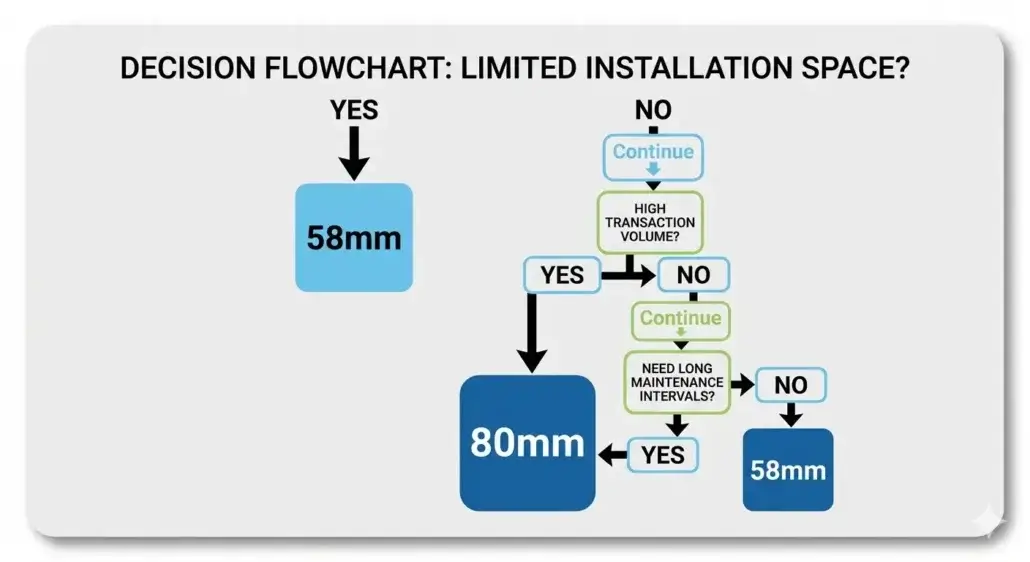
A 58mm kiosk printer is usually suitable for compact kiosks, short receipts, moderate transaction volume, and space-constrained installations. An 80mm kiosk printer is usually better for high-volume self-service terminals, longer receipts, larger paper roll capacity, clearer formatting, and reduced paper replacement frequency.
For system integrators, the decision should not be based on paper width alone. The better choice depends on kiosk space, receipt content, transaction volume, maintenance access, paper replacement cost, and long-term operating workload.
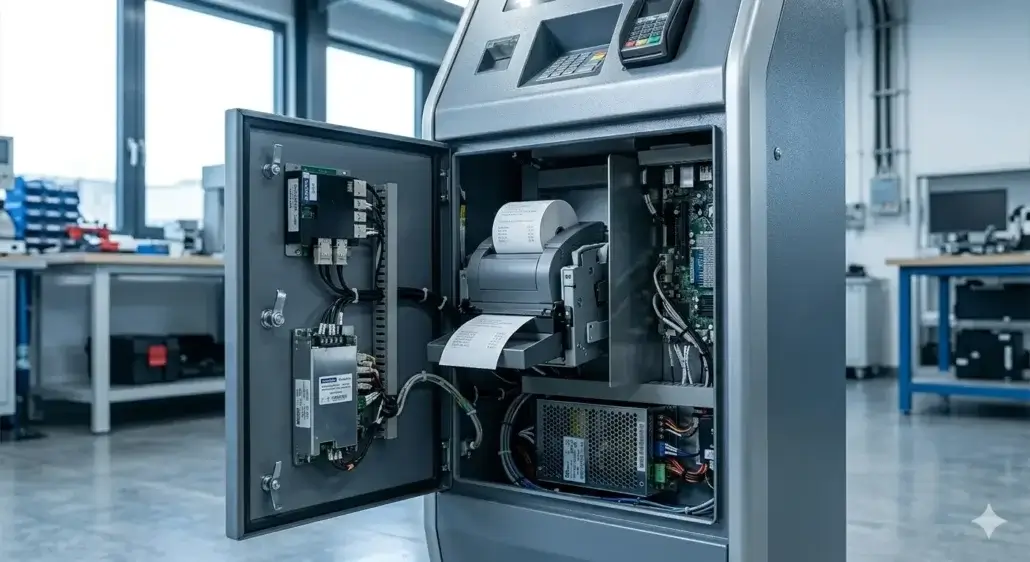
On a Datasheet, the Difference Looks Obvious
58mm printers use narrower paper.
80mm printers use wider paper.
At first glance, the decision appears straightforward.
Many comparison articles stop there.
But after enough deployments, experienced operators learn that paper width itself is rarely the main issue.
The more important questions are usually:
- How often will paper need to be replaced?
- How many transactions occur each day?
- How accessible is the printer?
- How costly are service visits?
- How much downtime is acceptable?
Those operational questions often matter more than the paper width itself.
Why Many Teams Initially Choose 58mm Printers
The advantages are easy to understand.
A 58mm printer typically allows:
- Smaller kiosk designs
- More compact internal layouts
- Lower paper consumption per receipt
- Reduced hardware footprint
- Greater flexibility in space-constrained installations
For projects with strict space limitations, these benefits can be significant.
This is particularly common in:
- Visitor management terminals
- Compact payment kiosks
- Access control systems
- Small self-service stations
From a design perspective, choosing 58mm often makes perfect sense.
And in many cases, it remains the correct decision.
Why Many High-Traffic Deployments Prefer 80mm Printers
The reasons are often operational rather than technical.
Larger paper rolls generally provide:
- Higher media capacity
- Longer intervals between replacements
- Reduced maintenance frequency
- Better suitability for longer receipts
- Improved readability for certain applications
These advantages become more noticeable as transaction volume increases.
A kiosk handling thousands of transactions each week places very different demands on the printer than a kiosk handling only a few dozen transactions per day.
Scale changes everything.
The Paper Width Discussion Often Becomes a Maintenance Discussion
One deployment manager once shared an observation that perfectly summarizes the issue:
“We spent weeks discussing paper width.
We spent the next three years discussing paper replacement.”
That statement may sound exaggerated.
In reality, it reflects a common pattern.
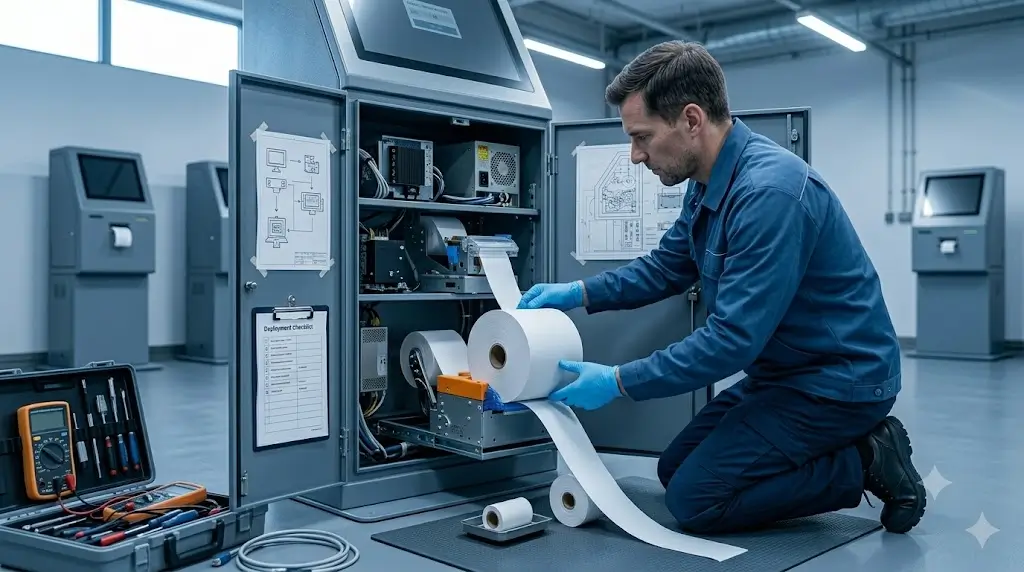
In one parking kiosk deployment, the project team selected compact 58mm printers to minimize cabinet size.
The installation was successful.
The printers performed reliably.
Users had no complaints.
Several months later, technicians noticed something unexpected.
Paper replacement visits were occurring far more frequently than originally estimated.
Nothing was wrong with the printer.
Nothing was wrong with the deployment.
The maintenance assumptions simply turned out to be inaccurate.
Smaller Receipts Do Not Always Mean Lower Costs
This is a common misconception.
Many teams assume narrower paper automatically reduces operating expenses.
Sometimes it does.
Sometimes it doesn’t.
The answer depends on:
- Receipt length
- Transaction volume
- Service costs
- Labor costs
- Site accessibility
If frequent paper replacement requires technician visits, the labor cost can quickly outweigh the savings generated by narrower media.
This is especially true for geographically distributed deployments.
After enough projects, operators begin evaluating total operating cost rather than paper consumption alone.
Saving paper is useful.
Avoiding unnecessary service visits is often more valuable.
Space Constraints Are Real
And They Should Not Be Ignored
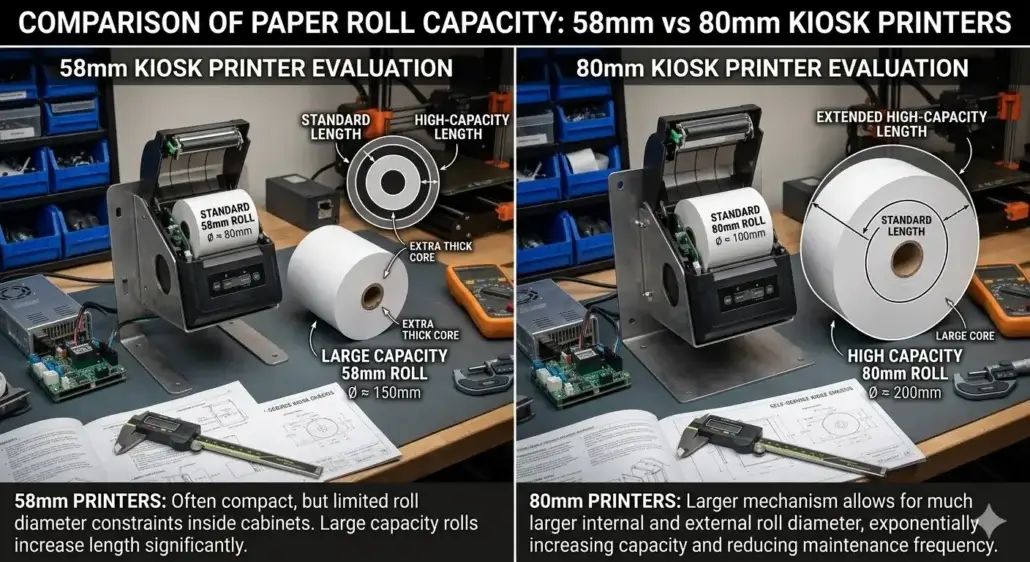
While maintenance often dominates long-term discussions, cabinet space remains an important consideration.
Some kiosk designs simply cannot accommodate larger printer assemblies or larger media rolls.
In those situations, a compact 58mm solution may be the only practical option.
Experienced integrators understand this trade-off.
The goal is not finding a universally superior printer.
The goal is finding the best balance between:
- Space utilization
- Serviceability
- Operating costs
- User requirements
Every deployment prioritizes these factors differently.
User Experience Can Influence the Decision
Paper width affects more than hardware design.
It also affects how information is presented.
Long receipts printed on 58mm paper may require:
- Smaller formatting
- Additional paper length
- More compact layouts
Meanwhile, 80mm receipts often provide:
- Larger QR codes
- Better readability
- More flexible formatting
- Improved presentation of transaction details
Whether this matters depends entirely on the application.
A parking receipt and a healthcare registration document have very different requirements.
Think About Year Three, Not Week Three
Most printer decisions look successful immediately after installation.
That is normal.
The real evaluation happens later.
After:
- thousands of paper roll replacements
- years of daily operation
- changing transaction volumes
- repeated maintenance cycles
This is when operational decisions begin revealing their true impact.
One experienced operator once told us:
“The printer choice was easy.
Living with the choice was the difficult part.”
That perspective tends to emerge only after deployment.
What Experienced Integrators Usually Ask
When evaluating 58mm versus 80mm printers, experienced teams often focus on operational questions.
For example:
- How many transactions will occur each day?
- How often can maintenance be performed?
- What is the cost of a service visit?
- How much internal kiosk space is available?
- What information must be printed?
Those questions usually produce better decisions than comparing paper width alone.
Because successful deployments are rarely determined by a single specification.
They are determined by how the entire system performs over time.
There Is No Universal Winner
This is perhaps the most important conclusion.
58mm printers are not inherently better.
80mm printers are not inherently better.
Each option solves a different set of problems.
Generally speaking:
58mm Printers
Often make sense when:
- Space is limited
- Receipts are short
- Transaction volume is moderate
- Compact design is a priority
80mm Printers
Often make sense when:
- Transaction volume is high
- Maintenance efficiency is important
- Longer receipts are required
- Media capacity is a priority
The correct choice depends on deployment realities rather than specifications alone.
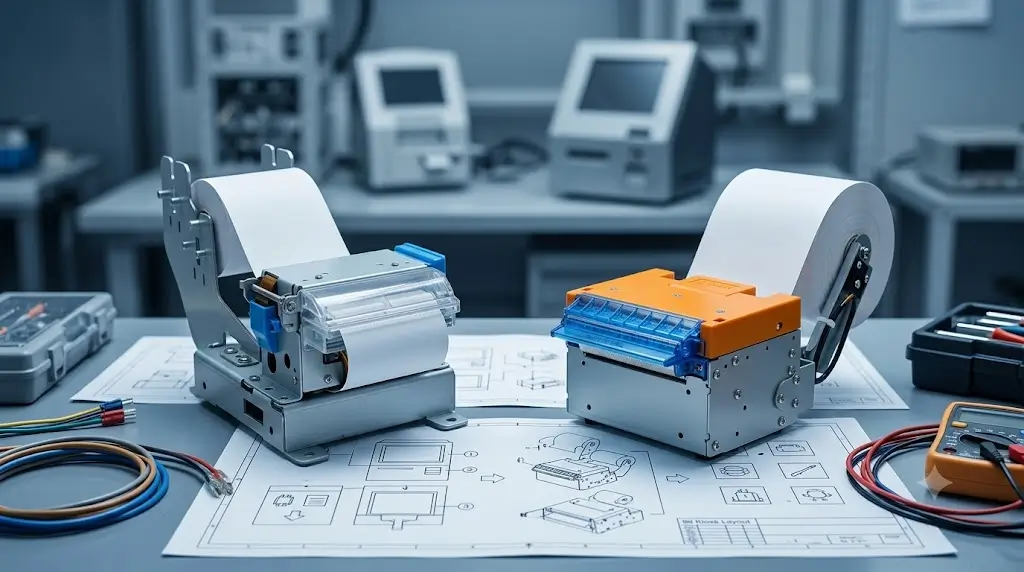
58mm vs 80mm Kiosk Printer Selection Comparison
| Selection Factor | 58mm Kiosk Printer | 80mm Kiosk Printer |
| Best suited applications | Compact kiosks, visitor terminals, access control systems, small payment stations | Parking systems, hotel kiosks, healthcare terminals, ticketing systems, high-volume self-service applications |
| Cabinet space requirement | Lower space requirement | Higher space requirement |
| Receipt content | Best for short receipts and simple transaction records | Better for longer receipts, QR codes, barcodes and detailed transaction information |
| Paper roll capacity | Usually smaller roll capacity | Usually larger roll capacity |
| Maintenance frequency | May require more frequent paper replacement in high-volume deployments | Can reduce paper replacement frequency in busy deployments |
| Operating cost | May reduce paper consumption but not always service cost | May reduce service visits but uses wider media |
| User readability | Limited formatting space | Clearer layout and easier reading for complex receipts |
| Deployment decision | Choose when compact design and short receipts matter most | Choose when capacity, readability and maintenance efficiency matter most |
Short Industry Takeaway
The difference between 58mm and 80mm kiosk printers is rarely about paper width alone.
It is often about maintenance workload.
Service frequency.
Operating costs.
Transaction volume.
Long-term deployment efficiency.
Those factors become increasingly important as deployments scale.
Because in self-service systems, paper width is usually discussed during procurement.
Operational consequences are discussed for years afterward.
Most teams think they are choosing between 58mm and 80mm paper.
Experienced operators know they are often choosing between different maintenance realities.
Frequently Asked Questions
Is a 58mm kiosk printer better than an 80mm printer?
Neither is universally better. The right choice depends on space constraints, transaction volume, receipt requirements and maintenance considerations.
Why do high-volume kiosks often use 80mm printers?
Larger media capacity can reduce paper replacement frequency and improve operational efficiency in busy environments.
Does 58mm paper reduce operating costs?
It can reduce paper consumption, but overall operating costs also depend on maintenance frequency, labor costs and service logistics.
Which paper width is better for compact kiosks?
58mm printers are often preferred in space-constrained applications where compact hardware design is important.
How should I choose between 58mm and 80mm printers?
Consider transaction volume, available cabinet space, receipt content requirements and long-term maintenance implications.
When should a self-service kiosk use a 58mm printer?
A self-service kiosk should use a 58mm printer when cabinet space is limited, receipts are short, transaction volume is moderate, and compact installation is more important than maximum paper roll capacity.
When should a self-service kiosk use an 80mm printer?
An 80mm printer is usually preferred when the kiosk handles high transaction volume, longer receipts, QR codes, barcodes, parking tickets, hotel receipts, or applications where reducing paper replacement frequency is important.
Does 80mm always mean lower maintenance?
Not always. An 80mm printer can support larger paper rolls and reduce replacement frequency in many deployments, but maintenance also depends on printer access, paper quality, transaction volume, and service planning.
Recommended SNRO Hardware Solutions
58mm Kiosk Printer Series
Ideal for:
- Compact kiosk designs
- Visitor management terminals
- Access control systems
- Space-constrained deployments
80mm Kiosk Printer Series
Ideal for:
- Hotel self check-in kiosks
- Parking systems
- Healthcare terminals
- High-volume self-service applications
Industrial Mini PC Solutions
Suitable for:
- Integrated kiosk platforms
- Self-service terminals
- Smart locker systems
Related Guides
- How to Choose a Kiosk Printer in 2026?
- Presenter Printer vs Auto Cutter Printer
- Kiosk Printer Selection Guide (Full System Overview)
- Why Kiosk Printers Jam in Real Self-Service Deployments?
- Why Paper Roll Capacity Matters More Than Many Teams Expect
- Why Maintenance Accessibility Matters in Self-Service Kiosk Design?
- Kiosk Printer SDK Guide
- Linux Kiosk Printer Integration Guide
Related Solutions
- Parking & Ticketing Hardware Solutions
- Ticket Vending Machine Hardware Solutions
- Queue Management Hardware Solutions
- Self-Checkout Hardware Solutions
- Banking Self-Service Terminal Hardware Solutions
- Queue Management Hardware Solutions
Planning a Kiosk Printer Project?
Many teams begin by comparing printer dimensions and paper width.Experienced operators eventually focus on something different.
How often the kiosk requires attention.
How much maintenance costs.
How easily the system scales.
Because paper width is only part of the decision.What matters most is how that decision affects the deployment years after installation.And that is where the best kiosk printer choices are usually made.
If you are choosing between 58mm and 80mm kiosk printers for a parking terminal, hotel self check-in kiosk, visitor management terminal, healthcare kiosk, payment machine, or compact self-service station, SNRO can help review your receipt format, paper width, kiosk space, transaction volume, interface requirement, and maintenance plan before sample testing.