


Banking Self-Service Terminal Hardware System Solutions
 Reliable Hardware for Modern Financial Self-Service Deployments
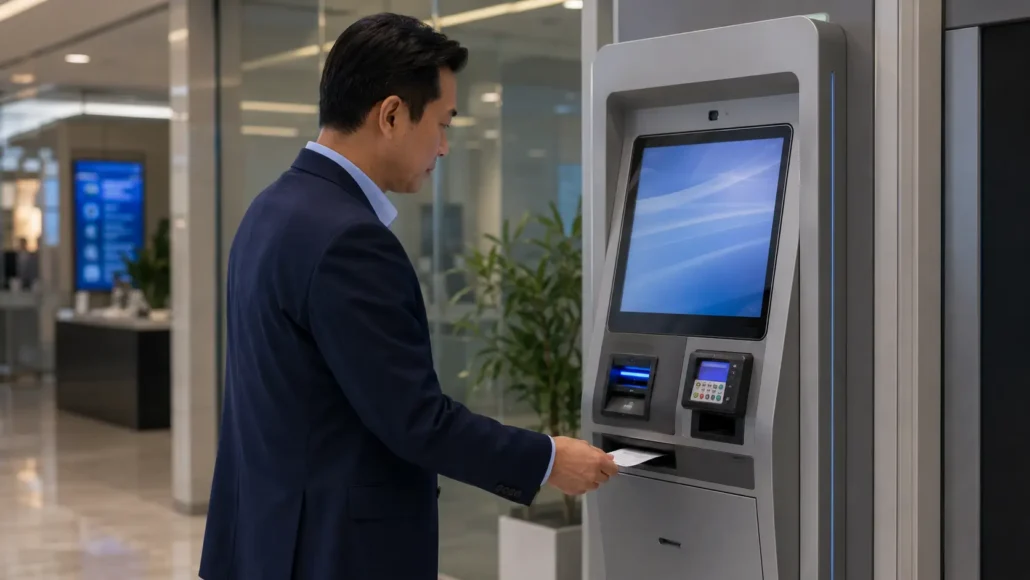
A banking self-service terminal hardware system is not defined by a kiosk or printer alone. It is defined by how reliably multiple hardware modules operate together within a secure financial service environment.
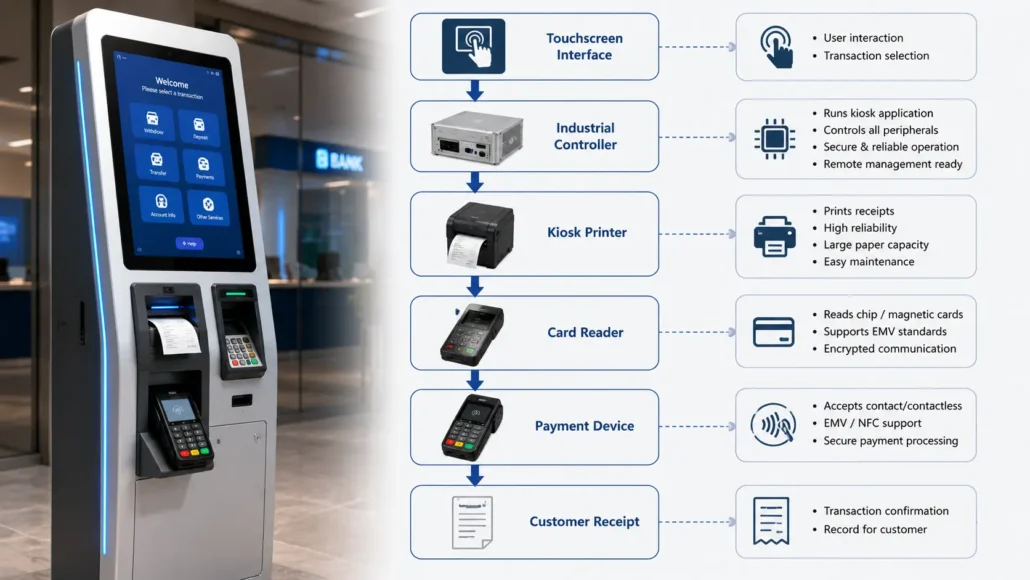
A complete banking self-service terminal hardware system integrates kiosk printers, card readers, barcode scanners, touchscreen interfaces, industrial controllers, authentication modules, and banking service platforms.
For system integrators, the real challenge is not individual transactions. The challenge is ensuring end-to-end workflow stability, including customer authentication, receipt printing, queue ticket issuing, service request handling, device coordination, and long-term branch network reliability.
Quick Answer
A banking self-service terminal hardware system typically includes:
- Touchscreen interface for customer interaction
- Kiosk printer for receipts, queue tickets, and confirmations
- Card reader for banking authentication
- QR / barcode scanner for mobile or document verification
- Industrial controller for device coordination
- Banking service platform integration
- Remote monitoring module for system diagnostics
System reliability depends on stable communication across all hardware layers rather than individual device performance.
What Is a Banking Self-Service Terminal Hardware System?
A banking self-service terminal hardware system is a multi-device integration platform designed to automate financial service workflows such as transactions, receipts, queue management, and customer authentication in banking environments.
It consists of the following functional layers:
- User Interface Layer: Touchscreen terminal for customer operations
- Authentication Layer: Card reader, QR scanner, or identity verification module
- Output Layer: Kiosk printer for receipts and queue tickets
- Control Layer: Industrial controller managing hardware execution
- Service Layer: Banking software platform handling transactions
- Monitoring Layer: Remote diagnostics and system status tracking
Although each module performs a specific function, overall system performance depends on workflow coordination across all layers.
System Architecture Overview
Touchscreen Display → Authentication Module → Card Reader / Scanner → Banking Platform → Kiosk Printer → Industrial Controller → Remote Monitoring System
Most operational issues occur at workflow transition points rather than within individual devices.
A banking self-service terminal is part of a broader self-service kiosk hardware system architecture. Kiosk printers, card readers, barcode scanners, industrial controllers and banking platforms must work together reliably under secure, continuous operation.
For a complete overview of how different kiosk hardware modules are planned, connected and maintained in unattended terminal systems, visit our Self-Service Kiosk Hardware System Hub.
Recommended Hardware Architecture for Banking Self-Service Terminals
| Hardware Module | System Role | Integration Consideration |
|---|---|---|
| Touchscreen interface | Customer interaction layer | Durability, UI responsiveness, privacy protection |
| Kiosk printer | Output layer | Paper capacity, presenter function, maintenance access |
| Card reader | Authentication layer | Security compliance, interface compatibility |
| QR / barcode scanner | Verification layer | Scan accuracy, lighting conditions |
| Industrial controller | System coordination layer | OS support, COM/USB stability, 24/7 operation |
| Banking platform | Service layer | API stability, security compliance |
| Remote monitoring | Maintenance layer | Device status tracking, error reporting |
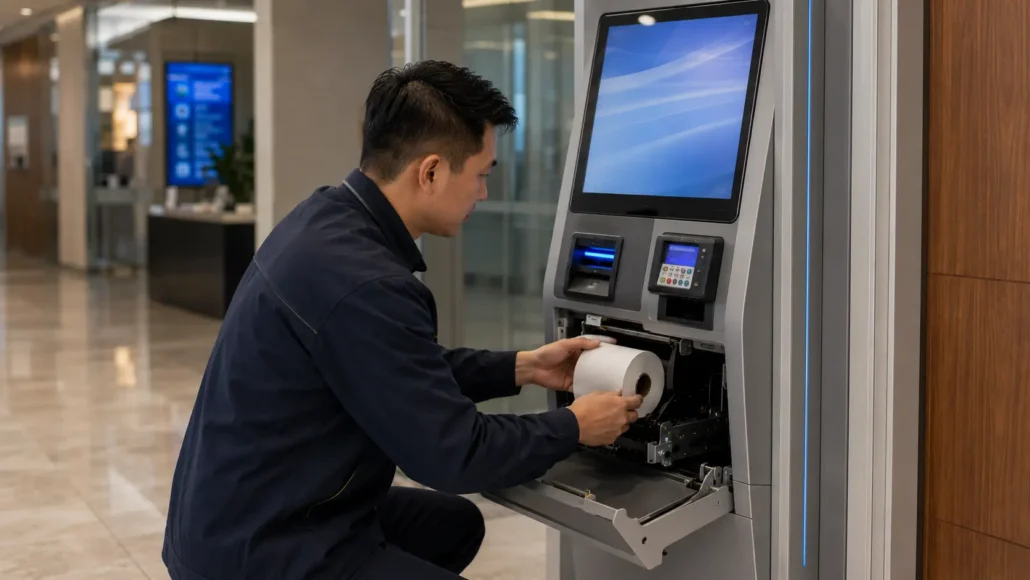
In banking self-service terminals, receipt and queue ticket printing are not secondary functions. Printer reliability directly affects transaction confirmation, customer service flow and branch maintenance workload.
For a broader overview of embedded printer modules, Linux driver support, SDK integration, presenter design and printer selection for unattended terminals, visit our Kiosk Printer Hub.
Hardware Selection Considerations
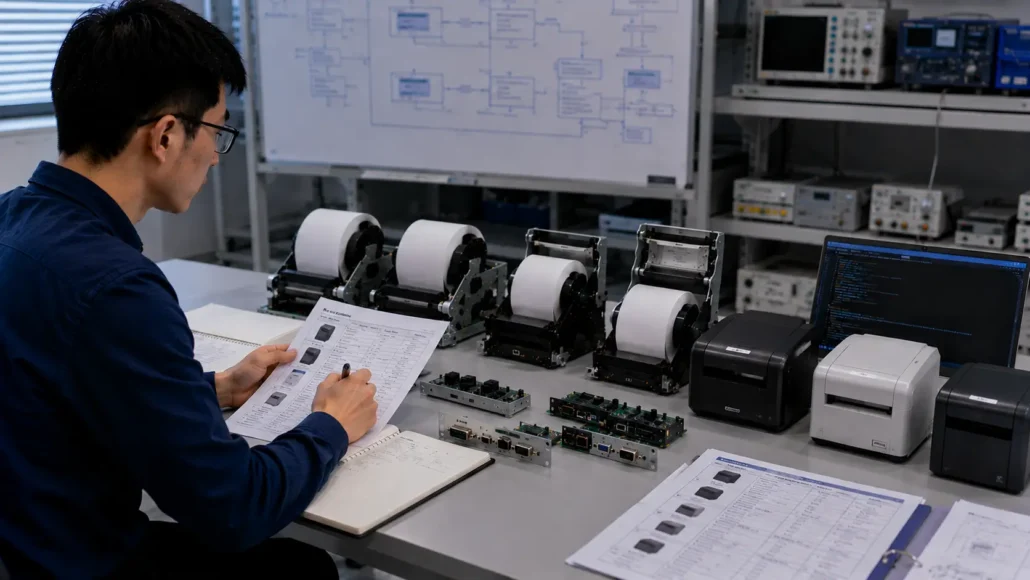
System integrators typically evaluate:
- Transaction volume and peak usage conditions
- Receipt and ticket handling requirements
- Paper roll capacity and maintenance cycles
- Operating system compatibility (Linux / Windows)
- SDK and API integration support
- Communication interfaces (USB / RS232 / Ethernet)
- Security and compliance requirements
- Maintenance accessibility
- Long-term branch scalability
Why Reliability Matters in Banking Systems
Banking customers expect uninterrupted service availability.
Downtime may result in:
- Service disruption
- Customer dissatisfaction
- Increased operational costs
- Additional maintenance workload
Therefore, system reliability is often more important than hardware specifications.
What Experienced Banking Integrators Usually Evaluate
When selecting hardware for banking self-service terminals, experienced system integrators often evaluate more than basic technical specifications.
Typical evaluation factors include:
- Long-term reliability history
- Maintenance accessibility
- Paper roll capacity
- Linux compatibility
- SDK availability
- Communication interfaces
- Receipt and ticket handling requirements
- Deployment environment
- Expected transaction volume
- Long-term support availability
For banking deployments, these operational considerations frequently have a greater impact on long-term success than print speed alone. Hardware that reduces maintenance effort and improves uptime often delivers greater value over the lifecycle of the deployment.
Typical Hardware Selection Matrix for Banking Self-Service Projects
| Deployment Type | Typical Hardware Configuration | Main Evaluation Point |
| Bank branch self-service terminal | Kiosk printer + card reader + touchscreen + industrial controller | Receipt reliability and branch service workflow |
| ATM receipt printing system | Embedded kiosk printer + banking controller | Receipt output stability and maintenance access |
| Queue management kiosk | Queue ticket printer + touchscreen + calling system | Customer routing and ticket printing reliability |
| Financial service center kiosk | Kiosk printer + scanner + card reader + service platform | Multi-service workflow and device integration |
| Government payment kiosk | Receipt printer + payment device + scanner + industrial controller | Payment confirmation and transaction record reliability |
| Insurance service terminal | Kiosk printer + scanner + touchscreen + software platform | Document handling and service confirmation workflow |
| Multi-service banking terminal | Standardized hardware + remote monitoring + banking platform | Scalable maintenance and long-term uptime |
Some banking self-service deployments are closely connected with queue ticket issuing and customer routing. When the terminal is mainly used for branch service guidance, ticket printing reliability and calling system coordination become critical.
For related hardware planning, see our Queue Management Hardware Solutions.
Recommended SNRO Hardware Modules for Banking Self-Service Terminals
SNR-KP800-VX Kiosk Printer for Banking Receipt Printing
Recommended for banking receipt printing, transaction confirmation output, branch self-service terminals and financial service kiosks requiring stable long-term receipt handling.
SNR-KP802-VX Presenter Kiosk Printer for Banking Self-Service Terminals
Suitable for high-volume financial service terminals that require controlled paper output, presenter function, receipt handling reliability and reduced uncollected paper issues.
SNR-KP805 Kiosk Printer for Banking Queue Ticket and Service Terminals
A practical printing module for banking queue tickets, service request confirmations and compact financial self-service terminals.
SNR-EP8200 Fixed Mount Barcode Scanner for Banking QR and Document Verification
Used for QR code verification, mobile banking code scanning, document reference reading and customer service workflow validation inside financial self-service terminals.
SNR-N8P Fanless Industrial Mini PC for Banking Self-Service Terminal Control
Designed to coordinate kiosk printers, scanners, card readers, payment devices and banking software communication in continuous branch or financial service deployments.
SNR-MR100 Motorized Card Reader for Banking Authentication
Designed for card reading, transaction authentication and secure card handling workflows in banking self-service terminals and financial kiosks.
Common Deployment Challenges
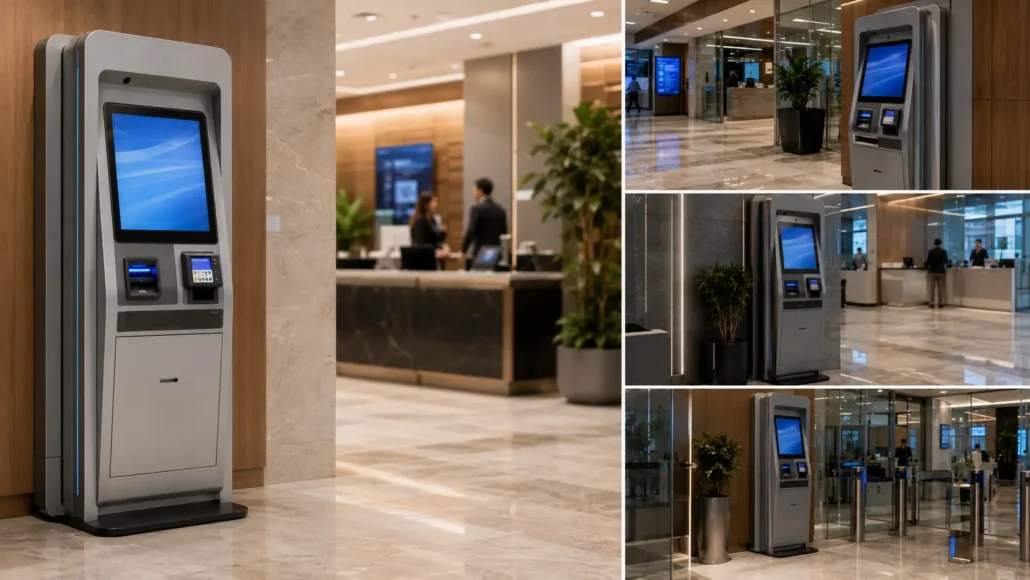
Continuous Operation Requirements
Banking terminals must operate continuously across distributed branch networks with minimal downtime.
Receipt and Ticket Reliability
Printing failures directly impact transaction completion and customer service flow.
Maintenance Accessibility
Large-scale banking deployments require efficient maintenance across multiple locations.
System Integration Complexity
Banking systems often require deep integration with customized software platforms and secure APIs.
Why Choose SNRO
SNRO provides integration-ready hardware designed for self-service banking deployments.
Advantages include:
- Linux-compatible kiosk printer solutions
- SDK resources for software integration
- Multiple communication interfaces
- Global deployment experience
- Long-term technical support
- Driver and development tool availability
- Mechanical design resources
Our hardware is designed to simplify integration while supporting long-term unattended operation.
FAQ
What is a banking self-service terminal hardware system?
A banking self-service terminal hardware system is an integrated platform combining kiosk printers, card readers, scanners, controllers and banking software to automate financial services.
What hardware is used in banking kiosks?
Typical components include kiosk printers, card readers, barcode scanners, touchscreen interfaces and industrial controllers.
How does a banking self-service terminal work?
It operates through a workflow of authentication, transaction processing, receipt printing and system coordination between hardware modules.
Why is a kiosk printer important in banking systems?
It is responsible for receipts, queue tickets and transaction confirmations in banking workflows.
What makes a reliable banking kiosk system?
Reliability depends on stable communication between hardware modules rather than individual device performance.
Can banking systems integrate with third-party platforms?
Yes. SNRO hardware supports SDKs, APIs and standard communication protocols for system integration.
Does SNRO provide SDK and driver support?
Yes. SNRO provides SDKs, drivers and protocol documentation for integration.
What causes most banking kiosk failures?
Most failures are caused by workflow interruptions, integration issues or printing problems rather than hardware defects.
Why is Linux compatibility important?
Many banking kiosks operate on Linux-based systems, making OS compatibility essential.
How important is maintenance in banking deployments?
Maintenance efficiency directly affects operational cost in large branch networks.
Can banking systems scale across multiple branches?
Yes. Standardized hardware and cloud integration allow scalable multi-branch deployment.
Typical Banking Projects We Support
Our hardware solutions are commonly deployed in a wide range of financial self-service applications.
- Bank Branch Self-Service Terminals
- ATM Receipt Printing Systems
- Queue Management Kiosks
- Financial Service Centers
- Customer Registration Terminals
- Government Payment Kiosks
- Retail Banking Service Machines
- Insurance Service Terminals
- Account Service Kiosks
- Multi-Service Financial Platforms
Different projects may require different combinations of kiosk printers, barcode scanners, industrial controllers and touchscreen interfaces depending on transaction volume, security requirements and deployment environment.
Related Products
- Kiosk thermal printers for banking receipt and ticket printing
- Fixed mount barcode scanners for banking QR and document verification
- Industrial mini PCs for financial self-service terminal control
- POS thermal receipt printers for bank counter and service desk printing
Technical Resources
- Linux drivers for banking kiosk printers
- Windows drivers for financial self-service printer modules
- SDK resources for kiosk printer integration
- Communication protocol documents for banking terminal peripherals
- CAD and mechanical drawings for kiosk installation
- User manuals for printer and scanner testing
Related Resources
- Kiosk printer integration knowledge hub
- Banking self-service kiosk printer selection guide
- Kiosk printer SDK and protocol integration guide for banking terminals
- Linux kiosk printer integration guide for banking self-service systems
- Paper roll capacity for banking receipt and queue ticket printers
- Maintenance accessibility for banking self-service terminal hardware
- Queue management hardware for banking service terminals
- Presenter printer vs auto cutter printer for unattended banking terminals
Related Solutions
- Queue management hardware for banking service terminals
- Self-checkout hardware systems for unattended payment workflows
- Ticket vending machine hardware for unattended payment and receipt output
Need Help Planning Your Banking Self-Service Terminal Hardware?
If you are planning a bank branch self-service terminal, ATM receipt printing system, financial service kiosk, queue management terminal, government payment kiosk, or multi-service banking platform, SNRO can help review your hardware architecture before deployment.
Share your transaction workflow, receipt or queue ticket requirement, authentication method, operating system, communication interfaces and expected branch deployment scale. Our team will recommend a suitable kiosk printer, scanner, industrial controller and integration hardware configuration for your banking self-service terminal.