


Blog
Common RFID Card Dispensing Challenges in Self-Service Kiosks

Quick Answer
Common RFID card dispensing challenges include card thickness variation, RFID card surface friction, static electricity, card warping, hopper loading errors, unstable card positioning, failed RFID reading or encoding, double-card feeding, and poor recovery after communication errors.
In real self-service kiosk deployments, these problems often appear after the system scales, when card batches change, maintenance intervals become longer, and environmental conditions begin affecting card movement and RFID performance.
The Dispenser Worked Perfectly—Until the RFID Cards Arrived
A customer once told us during a deployment review:
“The dispenser works perfectly.”
“Until we switch to RFID cards.”
At first, the statement seemed confusing.
The dispenser was unchanged.
The software was unchanged.
The operating environment was unchanged.
Yet dispensing performance became noticeably different.
Operators began reporting:
- Occasional feed failures
- Increased retry events
- Inconsistent card separation
- Higher maintenance frequency
The investigation eventually led to a simple conclusion.
The dispenser had not changed.
The cards had.
And that is a situation many deployment teams encounter when transitioning from standard PVC cards to RFID cards.
Because while RFID cards may look nearly identical on the surface, their physical characteristics can be surprisingly different.
Many RFID card dispensing issues appear to be dispenser problems.
In reality, they often begin with the cards themselves.
Why RFID Cards Behave Differently
From a user perspective, an RFID card often appears identical to a standard PVC card.
Internally, however, RFID cards contain additional components.
Depending on the design, this may include:
- RFID inlays
- Embedded antennas
- Additional lamination layers
- Specialized chip structures
These additions are essential for functionality.
They also influence how the card behaves mechanically.
In many deployments, the difference is small.
In others, the difference becomes significant enough to affect dispensing performance.
Thickness Variations Become More Important
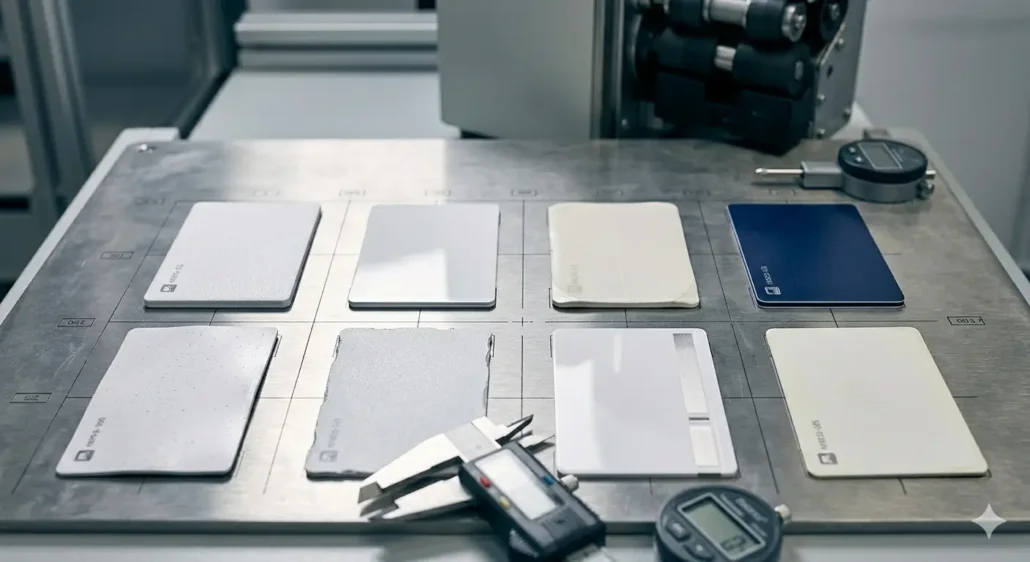
One of the most common RFID-related challenges involves card thickness.
Most dispensers are designed to operate within a specified thickness range.
RFID cards generally remain within industry standards.
However, small variations between manufacturers and card types can influence:
- Card separation
- Hopper performance
- Feeding consistency
- Roller engagement
During low-volume testing, these differences may go unnoticed.
In long-term deployments, they can become more visible.
Card Rigidity Can Change Feeding Behavior
Another factor that receives less attention is rigidity.
Not all RFID cards flex in exactly the same way.
Different constructions can produce different mechanical characteristics.
For example:
- Some cards remain highly rigid.
- Others exhibit slightly greater flexibility.
- Some develop minor curvature over time.
These differences influence how cards interact with:
- Hopper mechanisms
- Separation rollers
- Card guides
- Transport paths
The dispenser continues operating normally.
The cards simply respond differently.
RFID functionality is electronic.
RFID dispensing challenges are often mechanical.
Card Flatness Matters More Than Many Teams Expect
Flatness is a recurring theme in card issuance projects.
RFID cards are no exception.
Minor variations in flatness can affect:
- Card pickup consistency
- Separation accuracy
- Feeding reliability
The challenge is that many of these variations are difficult to detect visually.
A card may appear completely normal.
The dispenser may experience it differently.
This is one reason why intermittent RFID card dispensing issues can be difficult to diagnose.
Environmental Conditions Can Amplify Differences
Environmental factors affect all cards.
RFID cards are not immune.
Temperature fluctuations.
Humidity exposure.
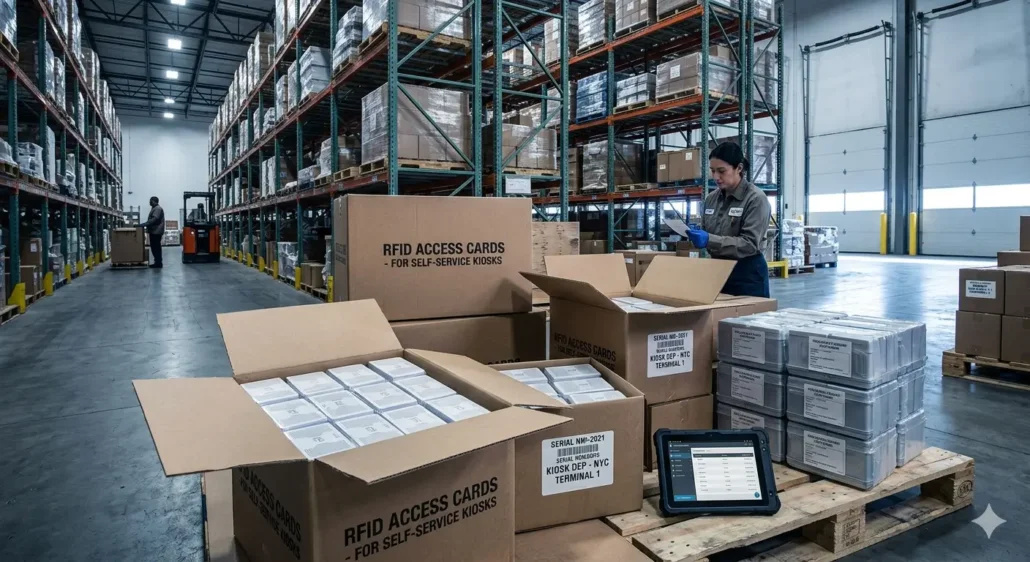
Long-term storage.
Transportation conditions.
These factors can gradually influence card behavior.
The effects may remain invisible in small deployments.
At larger scale, they become easier to observe.
Especially when multiple card batches are involved.
Mixed Card Inventories Create Unexpected Variables
This is a surprisingly common deployment scenario.
A project begins with one RFID card supplier.
Months later, inventory is supplemented from another source.
The cards appear identical.
Operationally, they may not be.
Differences in:
- Lamination methods
- Material composition
- Card rigidity
- Surface characteristics
can influence dispensing behavior.
The dispenser may now be handling multiple card types that technically meet the same specification.
Yet perform differently in practice.
Cards that look identical are not always mechanically identical.
High-Volume Deployments Reveal RFID Challenges Faster
Small pilot projects rarely expose every variable.
High-volume deployments do.
As transaction counts increase:
- More card batches enter circulation
- More environmental conditions appear
- More operational variations emerge
What seemed like an isolated incident becomes a recognizable pattern.
This is why some RFID card dispensing challenges only become visible after scaling.
The underlying factors were already present.
Volume simply made them easier to detect.

Common RFID Card Dispensing Challenges and What to Check
| Challenge | What to Check | Why It Matters |
| Card thickness variation | Test real production card batches | Thickness affects card separation and movement |
| RFID card surface | Check glossy, matte, laminated, or printed surfaces | Surface friction changes feeding behavior |
| Static electricity | Test cards after storage and handling | Static can cause cards to stick together |
| Card positioning | Confirm stable stop position near RFID reader | Reader or encoder needs correct card alignment |
| Failed RFID read | Verify frequency, card standard, reader distance | Incorrect matching causes failed card identification |
| Failed encoding | Test write-and-verify workflow | Unverified cards should not be delivered |
| Double-card feeding | Check hopper, separation parts, card condition | Two cards issued together can break credential control |
| Error recovery | Test jams, timeouts, reconnect behavior | Unattended kiosks need controlled recovery |
Hopper Performance Becomes More Critical
RFID cards place additional importance on consistent card presentation.
If cards vary slightly in:
- Thickness
- Rigidity
- Flatness
hopper performance becomes increasingly important.
A well-designed hopper helps maintain:
- Consistent positioning
- Stable pressure
- Predictable separation conditions
This reduces the likelihood that minor card variations become operational issues.
Which is one reason hopper design plays such an important role in RFID card issuance projects.
Maintenance Often Determines Long-Term Success
Many RFID dispensing systems perform well when new.
The real challenge appears over time.
As deployments mature, factors such as:
- Dust accumulation
- Wear patterns
- Environmental exposure
- Card variability
begin interacting.
Preventive maintenance helps identify these changes before they affect users.
Experienced operators understand that long-term RFID card dispensing reliability depends on maintaining both the dispenser and the operating environment.
What Experienced Technicians Usually Investigate First
When RFID card dispensing issues appear, experienced technicians often ask questions beyond the dispenser itself.
For example:
- Has the card supplier changed?
- Is this a new card batch?
- Have storage conditions changed?
- Are card thicknesses consistent?
- Has card flatness been evaluated?
These questions frequently reveal contributing factors that traditional hardware inspections miss.
Because the challenge is often not electronic communication.
It is physical card handling.
The RFID chip is rarely the reason a card fails to dispense.
The card’s physical characteristics usually deserve attention first.
Short Industry Takeaway
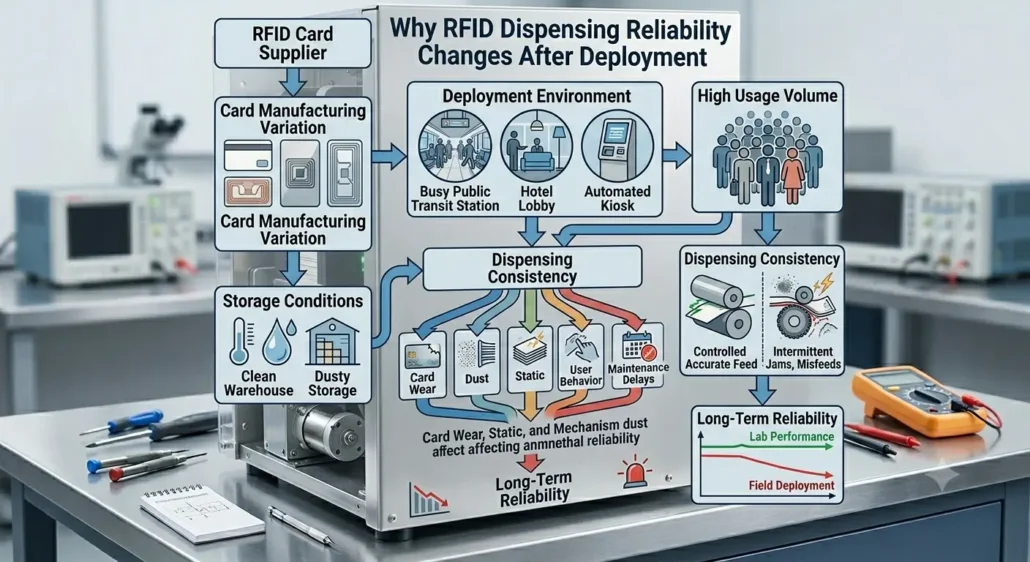
RFID cards introduce additional variables that can influence dispensing reliability.
Factors such as:
- Thickness
- Rigidity
- Flatness
- Storage conditions
- Manufacturing differences
all contribute to how cards behave inside a dispensing system.
The dispenser may remain unchanged.
The operating conditions may remain unchanged.
Yet RFID card construction alone can alter dispensing performance.
Because in many deployments, successful RFID card issuance depends as much on physical card behavior as electronic functionality.
A card can communicate perfectly with an RFID reader.
That does not automatically mean it will dispense perfectly.
Frequently Asked Questions
Why do RFID cards sometimes dispense differently than standard PVC cards?
RFID cards contain additional internal structures that may influence thickness, rigidity and feeding behavior.
Can RFID card thickness affect card dispenser performance?
Yes. Even small variations can influence card separation, hopper performance and dispensing consistency.
Are RFID card dispensing issues usually caused by the RFID chip?
Not typically. Most dispensing issues are related to physical card characteristics rather than electronic functionality.
Can different RFID card suppliers affect dispensing performance?
Yes. Manufacturing methods and material differences can create variations that influence card handling.
How can operators improve RFID card dispensing reliability?
Use consistent card suppliers, maintain proper storage conditions and evaluate card characteristics before deployment.
Why do RFID card dispensers fail to read cards sometimes?
RFID read failure may be caused by card standard mismatch, incorrect reader distance, card orientation, RF interference, unstable card position, or software integration issues.
Can RFID card quality affect dispensing reliability?
Yes. RFID card thickness, surface finish, flatness, edge condition, and storage environment can all affect card separation and movement.
How can integrators reduce RFID card dispensing problems?
They should test real card batches, confirm RFID compatibility, verify SDK functions, define error recovery logic, and test the dispenser inside the final kiosk enclosure.
Recommended SNRO Hardware Solutions
RFID Card Dispenser Series
Designed for long-term reliability in hotel, visitor management and access control applications.
Motorized Card Issuing Modules
Suitable for unattended environments requiring predictable dispensing performance.
Hotel Self-Service Check in Kiosk
Engineered for scalable deployments with ongoing operational requirements.
Related Guides
- Why Card Dispensers Become Less Reliable Over Time Even Without Mechanical Failure
- Why Card Dispenser Problems Become More Visible in High-Volume Deployments
- How Dust and Humidity Affect Card Dispenser Reliability
- Why Card Hopper Design Matters More Than Most Teams Realize
- How Card Storage Conditions Affect Card Dispenser Performance
Related Solutions
- Hotel Self Check-in Hardware Solutions
- Visitor Management Kiosk Solutions
- Self-Service Kiosk Hardware Solutions
- Smart Locker Hardware Solutions
- Access Control Kiosk Hardware Solutions
Learn more about system architecture: Card Dispenser Hub
Planning an RFID Card Issuance Project?
Many teams focus heavily on RFID functionality.
Encoding.
Reading distance.
System integration.
These factors are important.
Experienced operators often evaluate something else as well.
How the card behaves before it ever reaches the reader.
Because in self-service deployments, successful RFID card issuance begins with reliable card dispensing.
And reliable card dispensing often begins with understanding the physical characteristics of the card itself.
Need Help Testing RFID Card Dispensing Reliability?
Send SNRO your RFID card standard, card samples, kiosk layout, operating system, interface requirement, and issuance workflow. Our team can help evaluate the suitable card dispenser configuration before deployment.