


Smart Locker Hardware System Solutions

Reliable Hardware for Smart Locker Systems
Smart locker hardware systems are not defined by lockers alone. They are defined by how reliably the entire system operates under real-world conditions.
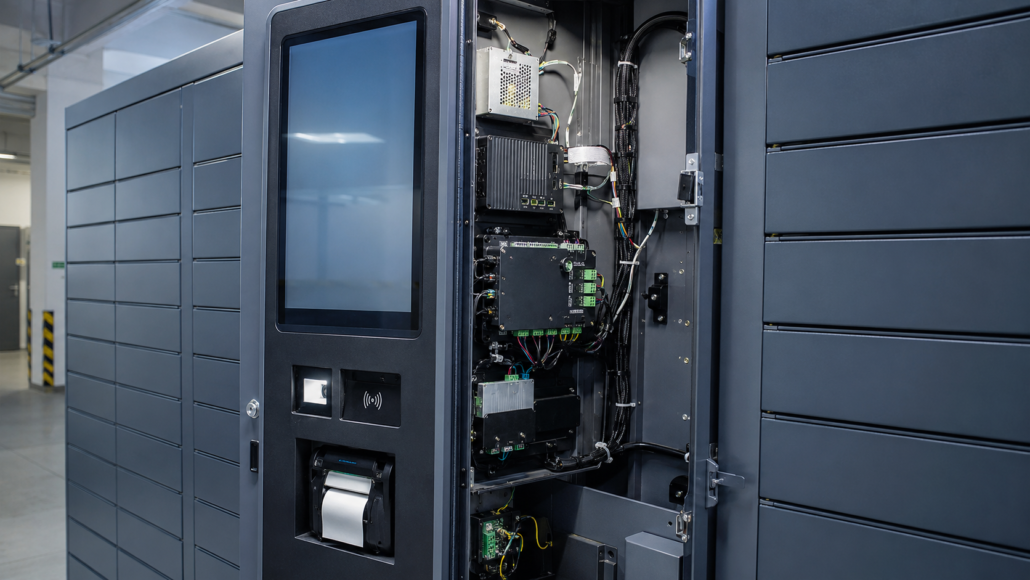
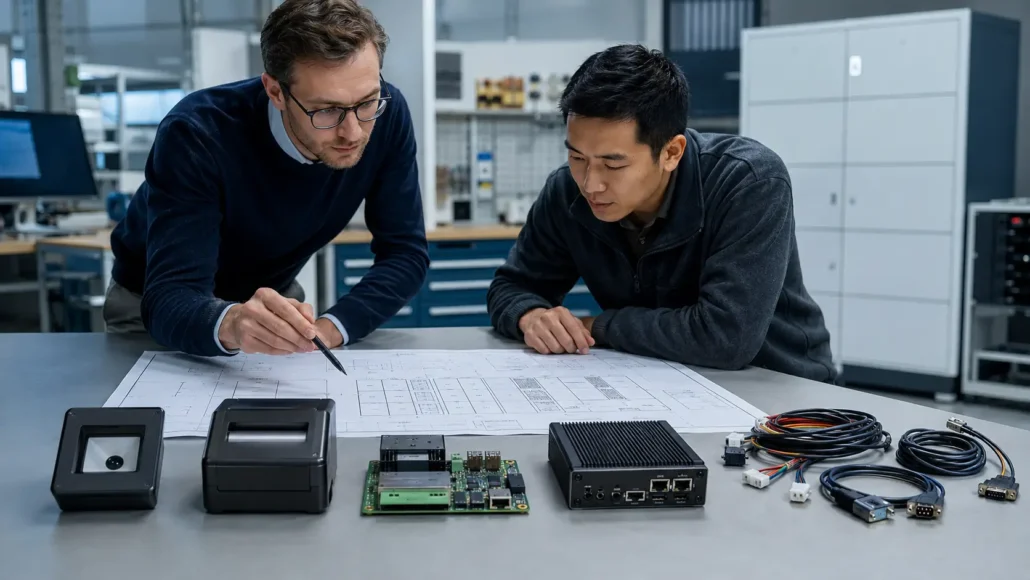
A smart locker hardware system typically integrates multiple components including a touchscreen terminal, QR or barcode scanner, thermal kiosk printer, locker controller, industrial mini PC, and optional RFID credential modules, all connected to a cloud-based locker management platform.
For system integrators, the real challenge is not unlocking lockers. The challenge is ensuring system stability across every step of the workflow, including user authentication, code verification, receipt or label printing, locker control execution, cloud synchronization, exception handling, and long-term maintenance in distributed deployments.
Quick Answer
A smart locker hardware system usually consists of the following core modules:
- User interaction terminal (touchscreen interface)
- Authentication devices (QR / barcode scanner / RFID reader)
- Output devices (thermal kiosk printer for receipts or labels)
- Locker controller (electronic lock control & status monitoring)
- Industrial mini PC (system coordination & communication hub)
- Cloud management platform (user authorization & remote monitoring)
Reliable system performance depends not on individual devices, but on how consistently these modules communicate under continuous, unattended operation.
Who This Smart Locker Solution Is Designed For?
This smart locker hardware system is commonly used by:
- System integrators developing unattended locker platforms
- OEM / ODM hardware manufacturers
- Parcel locker solution providers
- Retail click-and-collect system developers
- Campus and university infrastructure teams
- Healthcare and hospital asset management teams
- Smart city and logistics automation providers
What Is a Smart Locker Hardware System?
A smart locker hardware system is a multi-device automation architecture designed to support secure, unattended storage and pickup operations.
It is composed of several interconnected hardware layers:
- User Interface Layer → Touchscreen terminal for user interaction
- Authentication Layer → QR / barcode scanner or RFID credential system
- Output Layer → Thermal kiosk printer for receipts, pickup codes, or labels
- Control Layer → Locker controller managing lock status and execution logic
- Processing Layer → Industrial mini PC coordinating devices and software
- Cloud Layer → Remote management, user authorization, and data synchronization
While each device performs a specific function, long-term system reliability depends on the stability of communication across all layers.
Before selecting individual devices, many system integrators first evaluate the complete hardware workflow and module interaction. You can explore our Self-Service Kiosk Hardware System Hub for a broader system planning framework.
Not Every Smart Locker Project Requires the Same Hardware Architecture
Two smart locker systems with similar physical configurations may require completely different hardware architectures.
For example:
- A hospital locker system prioritizes reliability, hygiene, and continuous uptime
- A parcel locker network prioritizes transaction speed and high pickup volume
- A retail click-and-collect locker prioritizes user experience and fast workflow completion
Therefore, hardware selection should always follow workflow logic rather than physical layout.
What System Integrators Usually Ask Before Starting a Locker Project?
Before deploying a smart locker hardware system, integrators typically evaluate:
- Expected user traffic and transaction volume
- QR / barcode / RFID authentication workflow design
- Printer reliability and maintenance cycles
- Scanner performance under different lighting conditions
- Locker controller communication stability
- Operating system compatibility (Linux / Windows)
- SDK availability and API integration capability
- Environmental conditions (indoor / outdoor / humidity / dust)
- Multi-site deployment scalability
Over time, operational reliability becomes more important than initial hardware specifications.
Understanding a Typical Smart Locker Deployment
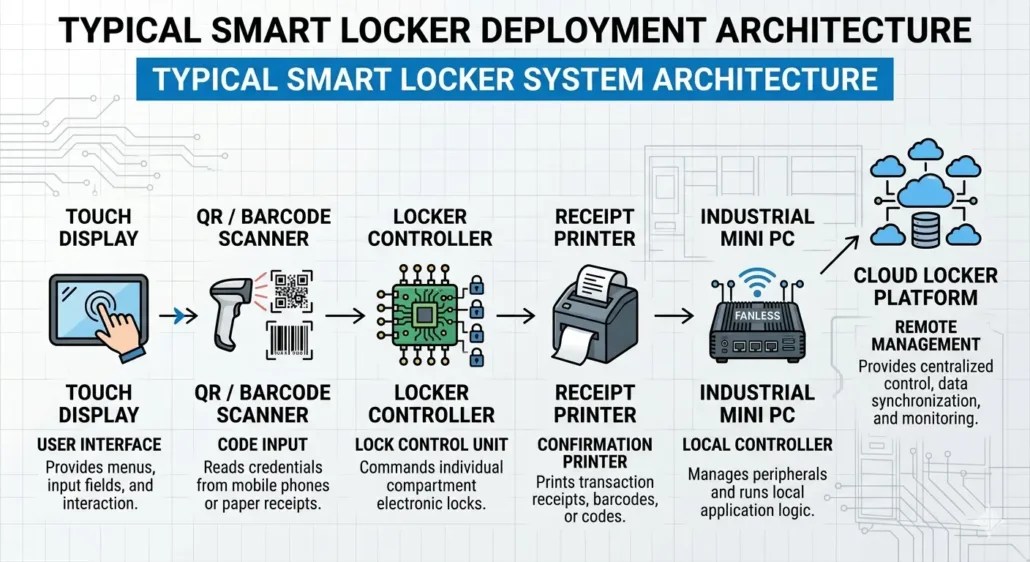
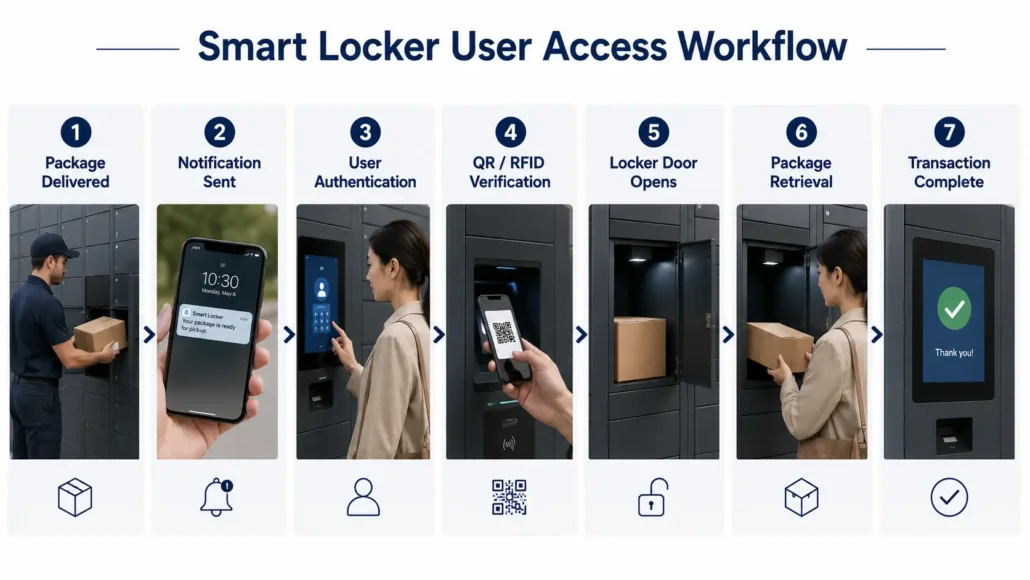
A typical smart locker workflow is structured as:
Touchscreen → QR/Barcode Scanner → Locker Controller → Thermal Printer → Industrial Mini PC → Cloud Platform
System instability often occurs not at the device level, but in communication between modules during high-frequency usage scenarios.
Recommended Hardware Architecture for Smart Locker Systems
| Hardware Module | Typical Function | Integration Consideration |
|---|---|---|
| Touchscreen terminal | User interaction & locker selection | Durability, UI responsiveness, installation environment |
| QR / barcode scanner | Pickup verification & authentication | Scan accuracy, lighting adaptability, interface type |
| Thermal kiosk printer | Receipt / label / pickup confirmation output | Paper capacity, anti-jam design, maintenance access |
| Locker controller | Door locking & status monitoring | Relay control stability, timing logic, safety handling |
| Industrial mini PC | System coordination & device communication | 24/7 operation, COM/USB support, OS compatibility |
| RFID card dispenser | Credential issuance for access control | Card type compatibility, reliability, capacity |
| Cloud platform | Remote management & data sync | API stability, network reliability, real-time updates |
Smart locker systems represent a complete self-service kiosk hardware architecture where scanners, printers, industrial controllers, locker controllers and cloud platforms must operate as one integrated system.
For a broader overview of unattended kiosk hardware architecture and system planning, visit our Self-Service Kiosk Hardware System Hub.
A Small Problem That Becomes a Big Maintenance Issue
One detail many teams underestimate during planning is user behavior.
Users may:
scan repeatedly
leave during pickup
repeat operations
abandon transactions
interact unexpectedly
Individually these actions appear minor.
Across thousands of daily interactions, they frequently become recurring maintenance requests.
This is one reason unattended locker deployments increasingly prioritize workflow consistency.
An Industry Pattern We Continue Seeing
Across smart locker deployments, many teams initially evaluate:
processor performance
screen size
locker quantity
interface options
Later priorities often shift toward:
maintenance requirements
communication stability
integration complexity
environment reliability
long-term operating cost
This pattern repeatedly appears across unattended deployments.
Things Teams Often Realize After Deployment
During early planning many teams focus on:
Can lockers open correctly?
Can users scan successfully?
Can packages be retrieved?
After deployment, priorities often shift:
How frequently is maintenance required?
How quickly can issues be diagnosed?
Can hardware be standardized?
Can support remain manageable as deployment expands?
Many operational questions only become visible after systems begin running at scale.
Signals Teams Often Monitor After Deployment Goes Live
After deployment, teams frequently begin tracking signals that were not obvious during testing.
Examples:
✓ repeated scan behavior
✓ pickup completion rates
✓ communication interruptions
✓ support request frequency
✓ maintenance cycles
These signals often become more important as deployments grow.
Deployment Notes
Hospital locker deployments may focus on:
✓ reliability
✓ hygiene
✓ continuous operation
E-commerce parcel locker projects frequently prioritize:
✓ transaction speed
✓ pickup efficiency
✓ traffic volume
Campus deployments often focus on:
✓ ease of use
✓ long operating hours
✓ simplified maintenance
Smart Locker Hardware Selection Usually Depends on Four Factors
Across many deployments, hardware decisions frequently depend on:
- User traffic volume
- Workflow complexity
- Environment conditions
- Long-term maintenance requirements
Projects with similar locker sizes may still require very different hardware combinations.
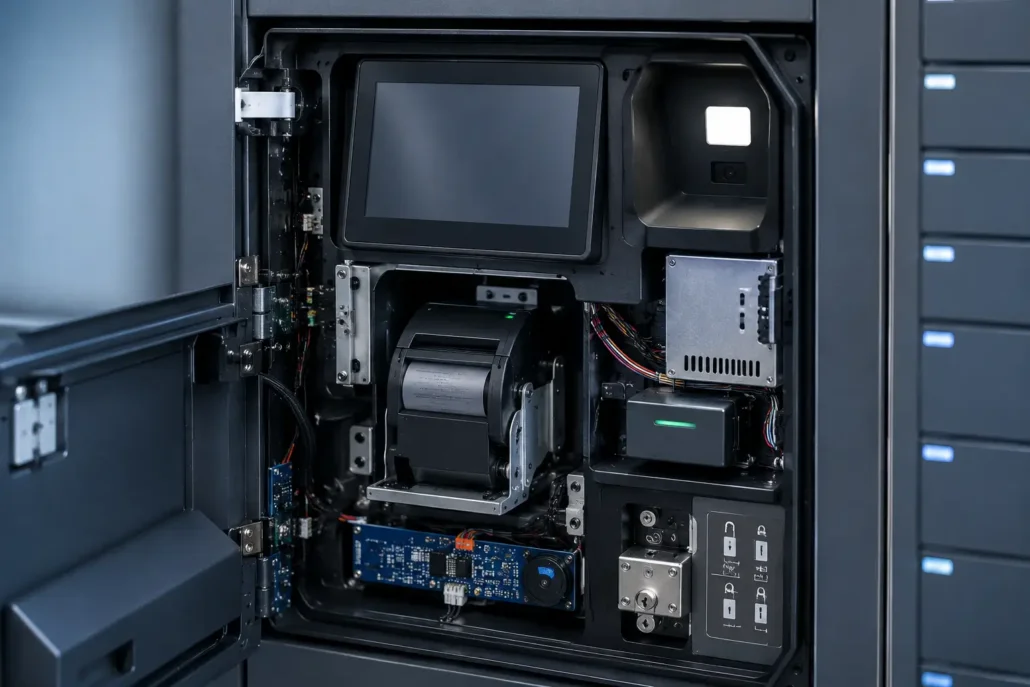
Recommended SNRO Products for Smart Locker Systems
Verification & Scanning
- SNR-EP8200 Fixed Mount Scanner for Smart Locker Authentication → QR / barcode pickup verification
Receipt & Transaction Output
- SNR-KP800-VX → High-volume locker transaction printing system
- SNR-KP805 → Receipt confirmation & pickup documentation
System Control Unit
- SNR-IBC-N8 Industrial Mini PC → Core controller for 24/7 operation
Credential Issuing
- SNR-K720 RFID Card Dispenser → Access card issuance & management
Smart locker projects that require RFID-based access control or reusable credentials often integrate automatic card dispensing hardware. For a broader overview of credential issuance technologies, visit our Card Dispenser Hub.
Common Smart Locker Deployment Challenges
Continuous Operation Requirements
Smart locker systems often operate 24/7 without on-site staff, making hardware reliability a critical requirement.
Credential Reliability
Failures in QR codes, RFID authentication, or printed pickup tickets can directly impact user access.
Environmental Conditions
Deployment environments may include:
- Outdoor installations
- Transport hubs
- Residential buildings
- Industrial environments
Dust, humidity, and temperature variation all affect long-term performance.
Maintenance Efficiency
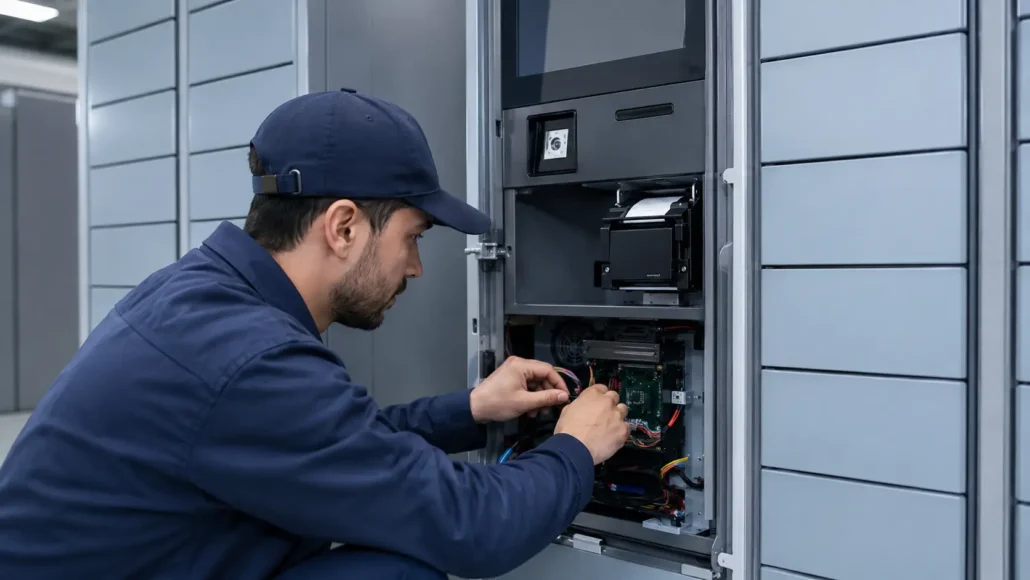
Distributed locker networks require hardware designed for fast servicing and minimal downtime.
Questions We Frequently Receive During Integration
“Can your hardware communicate with our locker controller?”
“Do SDKs support our software environment?”
“How many peripherals can operate simultaneously?”
“Can deployment scale across multiple locations?”
“Can future maintenance be simplified?”
Integration Support Often Becomes Important Later
During early evaluation stages teams often focus on specifications.
Later priorities frequently shift toward:
✓ SDK availability
✓ protocol compatibility
✓ driver support
✓ communication flexibility
✓ maintenance simplicity
These considerations frequently become more important during larger deployments.
Integration Timelines Sometimes Change During Projects
Early estimates frequently focus on installation.
Later phases may include:
• workflow adjustments
• communication testing
• software adaptation
• peripheral timing optimization
Many teams later discover integration timelines are influenced by workflow coordination as much as hardware compatibility.
Deployment Environment Matters More Than Many Teams Expect
Factors frequently influencing deployment include:
✓ traffic peaks
✓ operating schedules
✓ humidity
✓ temperature
✓ installation space
Why This Matters for Your Deployment
If your deployment eventually expands from one location to ten locations, hardware decisions made early may influence maintenance requirements for years.
Small compatibility decisions during planning often become larger operational costs later.
Typical Hardware Selection Matrix for Smart Locker Projects
| Deployment Type | Typical Hardware Configuration | Main Evaluation Point |
| Parcel locker system | Touchscreen + QR scanner + locker controller + industrial PC | Pickup verification and multi-locker control stability |
| Apartment package locker | QR scanner + thermal printer + locker controller + cloud platform | Resident pickup workflow and unattended operation |
| Campus smart locker | Touchscreen + scanner + receipt printer + industrial PC | High user traffic and simple maintenance |
| Hospital staff locker | RFID credential reader or dispenser + locker controller + industrial PC | Access control, reliability and hygiene requirements |
| Retail click-and-collect locker | QR scanner + receipt printer + payment or POS integration | Pickup speed, customer experience and transaction record handling |
| Multi-site locker network | Standardized hardware + remote monitoring + cloud management | Maintenance consistency and scalable deployment support |
What Experienced Smart Locker Integrators Usually Evaluate
When selecting hardware for smart locker systems, experienced deployment teams typically evaluate more than locker capacity or controller specifications.
Before deployment, define:
- User volume expectations
- Locker size and configuration
- Authentication method (QR / RFID / barcode)
- Printer or receipt requirements
- Scanner type and placement
- Controller communication interface
- Operating system requirements
- Environmental conditions
- Maintenance strategy
- Multi-location scalability plan
For large smart locker deployments, maintenance efficiency and workflow reliability often become more important than individual hardware specifications.
Short Industry Takeaways
Smart locker reliability frequently depends less on one device and more on how multiple devices behave together.
Hardware specifications matter.
Workflow consistency often matters more.
Why Hardware Reliability Matters in Smart Locker Systems
Many smart locker deployments begin with software platform selection.
Over time, operators often discover that hardware reliability plays an equally important role.
Reliable hardware influences:
- Successful package pickup
- User satisfaction
- Operational efficiency
- Maintenance requirements
- System availability
In high-volume locker networks, small hardware interruptions can quickly affect a large number of users.
For this reason, experienced operators evaluate long-term reliability alongside software functionality.
Frequently Asked Questions
What defines a reliable smart locker hardware system?
Reliability depends on system-level communication stability between scanner, printer, controller, and cloud platform—not single device performance.
Can smart locker systems operate 24/7?
Yes. Industrial-grade hardware is designed for continuous unattended operation.
Do smart locker systems support multiple authentication methods?
Yes. QR code, barcode, RFID, and mobile-based authentication can be combined depending on system design.
What causes most smart locker failures?
Most issues arise from workflow mismatch, communication instability, or environmental factors rather than hardware failure.
Why is an industrial mini PC required?
Because it ensures stable multi-device coordination and long-term 24/7 operation capability.
If Your Project Prioritizes This → Teams Often Consider This
| Priority | Teams Frequently Evaluate |
|---|---|
| Higher pickup volume | QR workflow efficiency |
| Compact space | Embedded structure |
| Lower maintenance | Anti-jam hardware |
| Multi-location deployment | Standardized hardware |
| Continuous operation | Industrial platforms |
Common Planning Mistakes We Frequently See
✓ selecting hardware before workflows are finalized
✓ underestimating peripheral communication requirements
✓ ignoring deployment environments
✓ planning only for current requirements
Early planning decisions often influence long-term flexibility.
Smart Locker Project Planning Checklist
□ expected user volume
□ locker dimensions
□ communication interfaces
□ deployment environment
□ operating system
□ peripheral quantity
□ maintenance requirements
A Common Deployment Scenario
A deployment team initially focused on locker quantity and interface design.
Early testing appeared successful.
Later during peak periods:
Users scanned repeatedly.
Traffic volume increased.
Communication timing shifted.
The issue was not hardware performance.
The issue was workflow behavior under real operating conditions.
Early Planning Often Reduces Future Changes
Some teams begin discussing hardware during planning.
Others reach out after operational issues begin appearing.
There is no single correct stage.
Early discussions sometimes identify considerations that become difficult to change later.
Typical Smart Locker Projects We Support
- Parcel Locker Systems
- Apartment Package Lockers
- Campus Smart Lockers
- Hospital Staff Lockers
- Retail Click-and-Collect Lockers
- Corporate Smart Storage Systems
- E-Commerce Pickup Stations
- Transportation Hub Lockers
- Cold Chain Locker Systems
- Multi-Site Smart Locker Networks
Different projects may require different combinations of printers, scanners, industrial controllers and credential management devices.
Related Resources
- Card Dispenser Hub
- Card Dispenser SDK and Integration Guide
- How to Choose a Card Dispenser for Smart Locker Systems
- Kiosk Printer SDK Guide
- Linux Kiosk Printer Integration Guide
- How to Choose a Fixed Mount Barcode Scanner
Related Products
Related Solutions
Need Help Planning Your Smart Locker Hardware Architecture?
Share your locker workflow, authentication method, operating system, expected pickup volume and controller requirements. Our engineering team will recommend the most suitable scanner, kiosk printer, industrial controller and credential management hardware for your smart locker deployment.