

Blog
How to Choose a Kiosk Printer for Ticket Vending Machines?

Introduction
In a ticket vending machine project, the printer is tested most clearly during the busiest moments: a passenger is waiting for a metro ticket, a driver needs a parking payment slip, a visitor is collecting an entry ticket, or a customer is trying to complete a transaction before a queue builds behind them.
When the ticket is printed, presented, collected, and scanned correctly, the machine feels reliable.
When the ticket jams, is pulled too early, remains uncollected, prints a weak barcode, or cannot be validated later, the issue quickly becomes an operation problem. Staff may need to open the machine, assist the user, reissue a ticket, or check the transaction manually.
That is why printer selection for ticket vending machines should start from the ticket delivery workflow, not only from print speed or resolution.
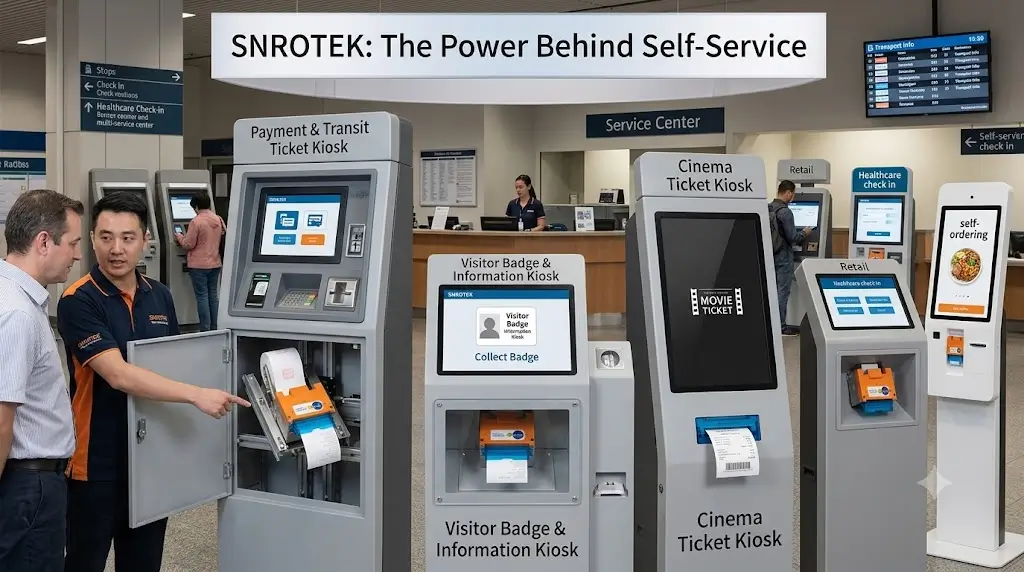
This guide is written for system integrators, ticketing solution providers, transportation equipment manufacturers, parking system providers, kiosk manufacturers, and OEM hardware teams that need to choose a kiosk printer for unattended or semi-attended ticket vending machines.
It focuses on ticket format, presenter output, retract function, paper capacity, QR code and barcode readability, Linux or SDK integration, cabinet design, maintenance access, and long-term deployment reality.
Quick Answer
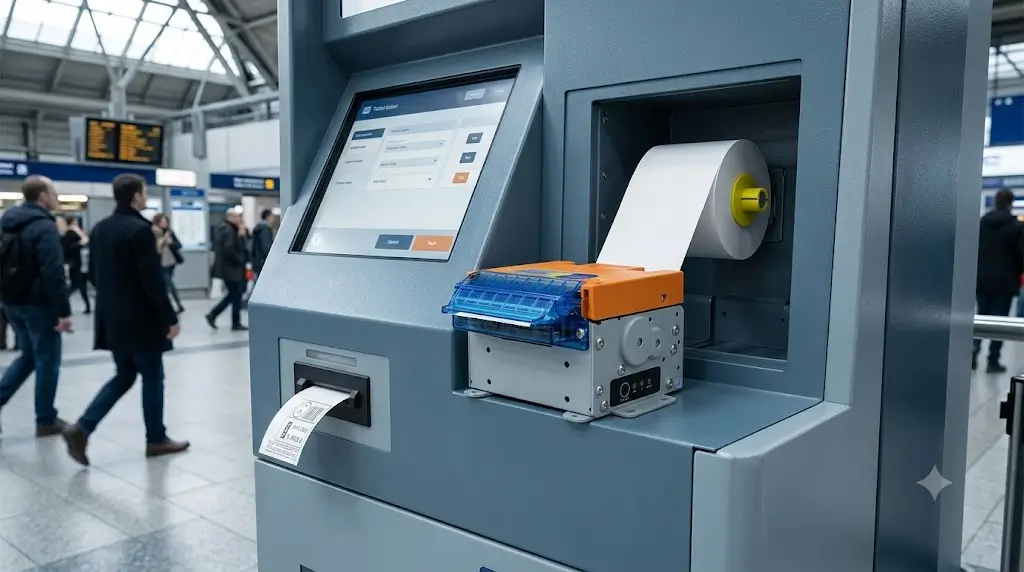
For many ticket vending machines, a presenter-based kiosk printer is often a practical starting point. It helps control ticket delivery, reduce early pulling, manage uncollected tickets, and support unattended operation.
An 80mm embedded thermal kiosk printer is usually preferred when the ticket includes QR codes, barcodes, route information, fare details, event data, parking references, validation records, or payment information.
A compact 58mm or 60mm printer may work for short queue tickets or simple claim slips, but it should be tested carefully if the ticket needs machine-readable codes or longer instructions.
Before choosing a printer, confirm:
- Real ticket layout
- QR code or barcode readability
- Presenter, retract, or standard cutter requirement
- Ticket collection behavior
- Paper roll capacity
- Cabinet space and output slot
- Paper replacement access
- Operating system and interface
- Linux, Windows, Android, driver, SDK, or command support
- Printer status feedback
- Peak ticket volume
- Pilot and rollout quantity
The best printer is the one that fits the complete ticket vending workflow, not only the one that prints fastest on a test bench.
Basic Concepts
What Is a Ticket Vending Machine Printer?
A ticket vending machine printer is an embedded kiosk printer installed inside a self-service ticketing terminal.
It prints the ticket, receipt, validation slip, payment record, entry reference, or claim document that the user needs after a transaction.
Depending on the system, it may print:
- Metro or railway tickets
- Bus or transit tickets
- Parking payment receipts
- Entry or admission tickets
- Venue tickets
- Visitor center tickets
- Queue or claim slips
- QR codes
- Barcodes
- Fare, route, zone, seat, time, or validation data
- Operator service records
The printer must fit the cabinet, communicate with the ticketing software, support the required operating system, and remain serviceable in public or unattended environments.
Why Ticket Vending Printers Are Different from Simple Receipt Printers
A simple receipt usually proves that a transaction happened.
A ticket vending machine printout often has to work as part of a later process. It may be scanned at a gate, checked at a parking exit, used to board transport, submitted for entry, or verified by staff.
This means ticket readability, paper handling, output control, and barcode quality matter more than a basic receipt printer comparison.
Why Presenter and Retract Functions Matter
In many ticket vending machines, users interact with the output slot under time pressure.
Some users pull the ticket as soon as paper appears. Some walk away before collecting it. Some use the machine during crowded peak periods.
A presenter printer can hold the ticket until printing and cutting are complete, then present it in a controlled way. A retract function can help manage uncollected tickets in some workflows.
These functions are especially important for unattended transportation, parking, and public service ticketing systems.
Ticket Vending Machine Printout Types
Before choosing the printer, prepare real ticket templates. A short test ticket is not enough.
| Printout Type | Typical Content | Printer Selection Focus |
|---|---|---|
| Transport ticket | Route, fare, zone, time, QR code or barcode | Code readability and stable ticket delivery |
| Metro or railway ticket | Station, trip data, fare, validation code | Presenter control and peak-hour output |
| Parking payment receipt | Entry time, exit time, fee, QR reference, payment record | Unattended reliability and paper handling |
| Venue ticket | Event, seat, time, ticket ID, QR code | Layout clarity and scanner validation |
| Admission slip | Entry reference, service note, QR code | Ticket collection and output slot design |
| Claim or pickup slip | Claim number, pickup code, location | Compact output and reference readability |
| Payment receipt | Amount, transaction ID, tax or service reference | 80mm layout and receipt clarity |
| Operator service record | Terminal ID, test print, service event | Maintenance access and status reporting |
This table helps project teams confirm whether the machine needs a controlled ticket delivery printer, a standard cutter printer, or a compact printer for short slips.
Presenter Printer vs Auto Cutter Printer
One of the first decisions in ticket vending machine design is whether to use a presenter printer or a standard auto cutter printer.
| Selection Point | Presenter Kiosk Printer | Auto Cutter Kiosk Printer |
|---|---|---|
| Best fit | Unattended or high-volume ticket vending machines | Simple or supervised ticket output |
| Ticket delivery | Holds and presents the ticket after printing | Cuts ticket directly at the outlet |
| Early pulling control | Better | Limited |
| Uncollected tickets | Can be considered in the workflow | Less control |
| Mechanical planning | Requires more output-slot planning | Usually simpler |
| Typical use | Transportation, parking, venue, public service ticketing | Queue tickets, simple receipts, controlled environments |
| Project risk | Needs cabinet and software planning | May be less suitable for unattended ticket handling |
For many ticket vending deployments, presenter-based printers are worth evaluating because ticket delivery is part of the service workflow.
An auto cutter printer may still be suitable for simple, staff-supervised, or low-risk ticket output. The final decision should match the real ticket collection behavior.
58mm / 60mm vs 80mm for Ticket Vending Machines
Paper width should be selected from the real ticket layout.
| Selection Point | 58mm / 60mm Printer | 80mm Printer |
|---|---|---|
| Best fit | Short queue tickets or compact claim slips | Full ticket vending machine tickets and receipts |
| Layout space | Limited | More room for ticket data and code layout |
| QR code room | Must be tested carefully | More layout room for QR codes |
| Barcode room | Limited by paper width | Easier to support validation layouts |
| Ticket content | Simple number or short reference | Route, fare, event, payment, validation, and instructions |
| Cabinet space | Easier for compact machines | Requires more internal and outlet space |
| Paper capacity | Often smaller in compact structures | Better for high-traffic sites if larger rolls are supported |
| Project risk | Ticket may become crowded if content grows | Needs more enclosure and service planning |
For transportation, parking, venue, and public service ticket vending machines, 80mm is often the safer direction when ticket data may expand or codes need reliable scanning.
Architecture / Workflow Layer
A ticket vending machine printer is part of a complete ticketing system. It should be reviewed together with payment, validation, software, and cabinet structure.
A typical ticket vending machine workflow may include:
User interface -> Ticket selection -> Payment or account validation -> Ticketing software -> Receipt or ticket trigger -> Presenter or cutter printer -> Scanner / validator / gate system -> Remote monitoring platform
Depending on the project, the machine may include:
- Touchscreen
- Payment terminal
- Card reader or account module
- QR code or barcode scanner
- Embedded ticket printer
- Presenter or retract mechanism
- Industrial mini PC or embedded controller
- Network module
- Remote monitoring software
- Ticketing platform integration
- Gate, parking, or validation system
- Service and maintenance interface
The printer should be selected before the cabinet is finalized. Late printer changes can affect ticket outlet design, paper roll position, service access, cable routing, driver testing, software commands, and ticket layout.
What Experienced Integrators Usually Evaluate
Experienced ticket vending teams usually evaluate the printer as part of the complete unattended transaction system.
Key questions include:
- What type of ticket will the machine print?
- Does the ticket include QR codes or barcodes?
- Will the ticket be scanned by a gate, validator, parking system, or staff device?
- Is 58mm, 60mm, or 80mm paper suitable for the real ticket layout?
- Does the machine need presenter output?
- Is ticket retract required for uncollected tickets?
- Will users pull the ticket before printing is complete?
- How many tickets may be printed during peak periods?
- How often will staff need to replace paper?
- Does the printer fit the cabinet, outlet, and service door?
- Does the printer support the selected operating system?
- Are Linux, Windows, Android, driver, SDK, or command resources available?
- Can the software monitor paper, cutter, presenter, retract, or jam status?
- Can the same printer support prototype testing and rollout?
These questions usually matter more than benchmark print speed. Ticket vending machines fail in the field when the ticket path, software workflow, or maintenance plan is not tested with real operating conditions.
Deployment Reality
Ticket vending machine printer projects often look simple during early testing. A sample ticket prints. The QR code appears. The payment flow triggers the printer. The cabinet drawing looks workable.
Field operation is different.
Passengers, drivers, visitors, and public users may operate the machine quickly. Some may pull tickets early. Some may not collect the ticket. Peak periods may create repeated output with limited staff nearby.
Maintenance also matters. A paper roll that is too small, a service door that is hard to reach, or a printer that cannot report status can turn a small design issue into a downtime problem.
Before rollout, project teams should test:
- Real ticket layout
- QR code and barcode readability
- Presenter or cutter behavior
- Retract behavior where required
- Paper roll capacity
- Paper replacement process
- Output slot alignment
- Driver and SDK resources
- Printer status feedback
- Peak-period repeated output
- Scanner, validator, or gate reading
The printer should be approved as part of the ticket vending workflow, not as a standalone printing device.
Application Scenarios
Railway and Metro Ticket Vending Machines
Railway and metro machines often operate in high-traffic environments with short peak periods.
Ticket delivery, barcode or QR readability, paper capacity, Linux or SDK support, and presenter behavior should be tested carefully.
Parking Ticket and Payment Machines
Parking systems may print payment receipts, entry references, exit records, validation slips, or QR codes.
Unattended operation, user pulling behavior, paper roll capacity, and output slot design are important.
Venue and Event Ticket Vending Machines
Venue machines may print admission tickets, seat references, event details, QR codes, and payment receipts.
High traffic before event start times makes paper replacement and printer status feedback important.
Visitor Center and Public Service Ticket Machines
Visitor centers and public service terminals may print admission slips, service numbers, reservation records, or pickup references.
The printer should support clear output, simple maintenance, and stable operation in semi-attended environments.
Queue and Claim Ticket Machines
Some ticket vending or service terminals only print short queue or claim tickets.
A compact printer may be enough, but the real printout should still be checked for code size, line wrapping, and service instructions.
How to Choose
1. Confirm the Real Ticket Template
Start with the real ticket template, not a sample test print.
Confirm whether the ticket includes:
- Ticket number
- QR code
- Barcode
- Route, station, zone, or gate information
- Event, seat, or entry details
- Parking entry, exit, or payment data
- Validation reference
- Date and time
- Terminal ID
- Operator or venue information
- Terms or service notes
If the ticket is information-dense, 80mm paper is usually easier to use.
2. Decide Whether Presenter Output Is Needed
If the machine is unattended, high-volume, or used in public environments, evaluate presenter output early.
Presenter design should be reviewed with the output slot, cabinet depth, software timing, ticket collection behavior, and service access.
3. Confirm Whether Retract Is Required
Some ticket vending machines need to manage uncollected tickets.
If retract behavior is required, confirm the printer structure, paper path, software logic, waste path or collection plan, and status feedback before cabinet design is locked.
4. Choose Paper Width
Use 58mm or 60mm only when the ticket is short and simple.
Use 80mm when the ticket includes QR codes, barcodes, route details, event data, payment references, validation information, or longer instructions.
5. Review Paper Roll Capacity
Paper capacity directly affects service frequency.
In railway, metro, parking, and venue applications, frequent paper replacement can increase operating cost and reduce machine availability.
6. Check Cabinet Space and Maintenance Access
The printer must fit the machine with enough room for paper roll, output path, presenter or cutter structure, retract path where required, cables, service door, and jam clearing.
If staff cannot replace paper or clear a jam quickly, the machine may stay offline during busy periods.
7. Confirm Operating System, Interface, and SDK
Ticket vending machines may use Linux, Windows, Android, or embedded controller platforms.
Before selecting the printer, confirm:
- USB, serial, Ethernet, or other interface requirement
- Driver availability
- SDK availability
- Command support
- Linux compatibility where needed
- Printer status feedback
- Presenter, retract, cutter, or jam status
- Compatibility with the ticketing software
8. Test With the Real Validation Workflow
Sample text is not enough.
Test printed QR codes, barcodes, ticket numbers, and validation references with the actual scanner, gate, parking system, or staff validation device.
Printer output and validation workflow should be approved together.
Recommended SNRO Printer Shortlist
The following SNRO printer directions can be used as practical starting points. The final model should be confirmed according to ticket format, presenter or retract requirement, paper capacity, enclosure design, operating system, interface, and rollout quantity.
SNR-KP802-VX Presenter Kiosk Printer
Recommended for ticket vending machines that need controlled ticket delivery, presenter output, and unattended operation.
Typical evaluation scenarios include railway ticketing systems, metro ticket vending terminals, parking payment machines, high-volume ticket issuance, and public service ticketing systems.
Use this direction when ticket collection control, early pulling risk, uncollected ticket handling, or long-term unattended operation matters. Verify cabinet space, output slot design, presenter workflow, retract requirement, software status handling, and Linux or SDK support before final approval.
SNR-KP800-CM Parking Ticket Printer
Recommended for parking ticket machines, payment receipt terminals, validation ticket output, and ticket vending projects where the printed record may be used for entry, exit, payment proof, or service verification.
Use this direction when the project needs an 80mm-class ticket or receipt printer with parking and ticketing relevance. Verify the real ticket layout, paper path, cabinet space, interface, operating system, and service access before selection.
SNR-KP800-VX 80mm Kiosk Printer
Recommended for general 80mm ticket vending or public service kiosk projects that need embedded ticket or receipt output.
Typical evaluation scenarios include general ticketing applications, public service kiosks, venue ticket terminals, and payment receipt output.
Use this direction when the project needs 80mm layout flexibility and practical integration. Verify paper capacity, mechanical fit, interface, and software support before selection.
SNR-KP602-VX Compact Kiosk Printer
Recommended for compact ticket vending machines, queue ticket systems, visitor terminals, and short ticket workflows.
Use this direction only when the ticket format is short and the cabinet has limited space. Test the real ticket, QR code, barcode, and service content before selecting a compact printer.
Final Selection Checklist
| Check Item | Why It Matters |
|---|---|
| Real ticket template | Confirms paper width, layout, QR code, barcode, and validation content |
| Presenter requirement | Determines whether controlled ticket delivery is needed |
| Retract requirement | Confirms how uncollected tickets should be handled |
| Scanner or validator workflow | Confirms whether printed codes can be read in the real system |
| Peak ticket volume | Helps evaluate paper capacity and output reliability |
| Paper roll capacity | Affects refill frequency and maintenance cost |
| Cabinet drawing | Checks printer depth, output slot, paper roll space, and service access |
| Paper loading method | Determines whether staff can replace paper quickly |
| Operating system | Confirms Linux, Windows, Android, driver, or SDK support direction |
| Interface requirement | Helps match USB, serial, Ethernet, or other communication needs |
| Printer status feedback | Helps software handle paper-out, cutter, presenter, retract, or jam events |
| Pilot or rollout quantity | Helps plan model consistency and supply planning |
If several items are unclear, avoid final printer approval. Ticket vending machines are expensive to rework after cabinet tooling and software integration are already fixed.
What Successful Deployments Usually Have in Common
Successful ticket vending machine printer deployments usually share several patterns.
The printer is selected before enclosure design is finalized.
Presenter or retract behavior is confirmed early where needed.
Ticket layouts are tested with real transaction data.
QR codes and barcodes are verified with real scanners, validators, or gate systems.
Paper roll capacity is matched to expected traffic.
Paper replacement is simple for the maintenance team.
The output slot matches user collection behavior.
The software can monitor printer status where required.
Driver, SDK, and Linux resources are checked before prototype approval.
Pilot testing reflects realistic peak traffic.
These details may look small during planning. In the field, they often decide whether the ticket vending machine stays available during high-demand periods.
Conclusion
Choosing a kiosk printer for ticket vending machines is not only about print speed, resolution, or price.
The printer must match the ticket format, presenter or retract workflow, scanner validation process, paper capacity, cabinet structure, operating system, SDK resources, maintenance plan, and rollout environment.
For many unattended ticket vending systems, a presenter-based kiosk printer should be evaluated early. For parking and ticketing receipt workflows, an 80mm ticket printer direction may be practical. For compact queue or claim ticket machines, a smaller printer may work if the real ticket format is simple.
The safest approach is to test the printer with real tickets, real validation workflows, real cabinet constraints, and realistic peak traffic before mass production.
Need a Printer Shortlist for Your Ticket Vending Machine Project?
Share your ticket template, presenter or retract requirement, QR code or barcode sample, scanner or validator workflow, cabinet drawing, operating system, interface requirement, expected peak ticket volume, and rollout quantity. SNRO can help you evaluate a practical printer direction for prototype testing and deployment planning.
Request a Ticket Vending Printer Shortlist
Related Resources
Hub and General Guides
- Kiosk Printer Hub
- Kiosk Printer Buying Guide
- How to Choose a Kiosk Printer for Ticket Kiosks
- 58mm vs 80mm Kiosk Printer Guide
- Presenter Printer vs Auto Cutter Printer Guide
Related Application Pages
- Ticket Vending Machine Hardware Solutions
- Parking Ticketing Solutions
- Queue Management System Hardware
Product References
- SNR-KP802-VX Product Reference
- SNR-KP800-CM Product Reference
- SNR-KP800-VX Product Reference
- SNR-KP602-VX Product Reference
Technical Resources
FAQ
What type of printer is commonly used in ticket vending machines?
Presenter-based kiosk printers are commonly evaluated for ticket vending machines because they support controlled ticket delivery and unattended operation.
Why is ticket retract functionality important?
Ticket retract functionality can help manage uncollected tickets in some workflows. It should be confirmed early because it affects printer structure, cabinet design, software logic, and maintenance access.
Is an 80mm printer better for ticket vending machines?
For many ticket vending machines, 80mm is more flexible because it gives more room for QR codes, barcodes, route information, event details, payment records, and validation content.
Can a 58mm printer be used in a ticket vending machine?
A 58mm or 60mm printer may work for short queue tickets, claim slips, or simple service tickets. For full ticket vending workflows, real ticket templates should be tested carefully before choosing a compact printer.
Does Linux support matter for ticket vending systems?
Yes. Many transportation and public service ticketing platforms use Linux or customized software environments. Driver, SDK, command, and status feedback support should be checked before printer approval.
Why does paper roll capacity matter?
Paper roll capacity affects maintenance frequency. In high-traffic ticket vending locations, frequent paper replacement can increase service cost and reduce machine availability.
What should be tested before choosing a ticket vending machine printer?
Test the real ticket layout, QR code and barcode readability, presenter or retract behavior, paper replacement process, output slot alignment, driver or SDK support, printer status feedback, and peak-period operation.
Can SNRO recommend a printer for a ticket vending machine project?
Yes. SNRO can help evaluate a practical printer direction based on ticket format, presenter or retract requirement, paper capacity, operating system, interface, enclosure space, validator workflow, and expected deployment quantity.